I already wrote about how skills are the new agents. And I wrote how the distribution of skills is a mess right now, and the skills universe is fragmented.
I was wondering whether there was a package manager for skills, so I searched and found lots of new proposals on package managers for skills.
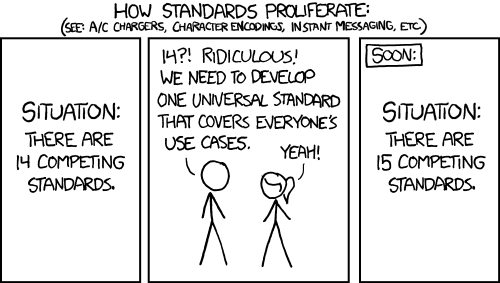
The result of my search felt a lot like this…
However, in the middle of my search, I found this post about pixi-skills. The key idea is: agent skills are just markdown files, software has solved distributing text files, so use a package manager instead of inventing a new one?
The author is right, but pixi means adopting conda in every project, and most folks outside of Data Science don’t use Conda.
But if skills are just packages, then what’s the smallest thing that already works?
The gap, and the security problem
If you’ve used agent skills, you’ve probably installed them the imperative way,
something like npx skills add owner/repo. It grabs whatever’s on main
right now and copies it into .claude/skills/, .codex/skills, whatever.
Or maybe you just git-cloned a skill repo, and then installed it directly. Or maybe you used a cli like Vercel’s.
These approaches are quick, but they leave four important holes that every package ecosystem closed years ago:
- No manifest. Nothing records which skills a project depends on, so there’s no “clone and restore.”
- No version pinning. You’re tracking a branch head. Upstream edits change your agent’s behavior silently.
- No lockfile or integrity. Even a pinned tag can be force-moved.
- No CI story. No way to assert “the skills in this build are exactly the ones we reviewed.”
That second one matters more than it looks. A skill is a prompt injected into a privileged agent. This goes beyond reproducibility: it is a huge supply-chain problem, and skills are not just used by developers.
What the landscape provides already is not enough
vercel-labs/skills has the ecosystem and a directory, but no versioning model. paks has the versioning model but builds a whole new registry to get it. This means that the tool with the reach has no pinning, and the tool with the pinning has no reach. There are also a gazillion approaches similar to paks.
The boring answer
We don’t need (and don’t want!!!) a new file or a new registry.
package.json already sits in lots of repos, tolerates extra fields,
and npm already pins git dependencies to exact commit SHAs in a lockfile.
That means that the only missing piece is trivial: copy the SKILL.md directories into the right agent folders.
So I built skills-lock to prove it. It has zero dependencies and supports any git repo as a registry:
{
  "skills": {
    "frontend-design": "anthropics/skills",
    "code-review": "acme/skills#v2.1.0"
  },
  "skillsConfig": { "agents": ["claude-code", "cursor"] }
}
$ npx skills-lock install
+ frontend-design anthropics/skills @ 575462609294 → claude-code, cursor
✓ installed, skills-lock.json writtenYou can commit the lockfile, then teammates and CI run skills-lock install --frozen
and get byte-identical skills, verified by content hash, or a hard failure.
Where it’s going
skills-lock is on npm and works today, but it’s a proposal more than a product.
The endgame I actually want isn’t another competing tool (that’s the xkcd 927
trap) It’s to have this workflow (manifest in package.json, a lockfile, --frozen in CI)
getting absorbed into the tool (or tools) that already have the ecosystem.
I’ve opened that conversation with the maintainers at Vercel.
If you think skills should be pinnable like every other dependency, come argue about
it there. And if you want to try it: npx skills-lock or npm i -g skills-lock to go global.